
How can relaxing help with period pain and PMS?
Alyson Tyler | FEB 18, 2025
yoga
relaxation
de-stress
massage
ebook
The links between yoga, massage and reducing pain
Quite a few menstrual issues feature pain: PMS, cramps, painful periods, pelvic pain, lower back ache, referred pain in pelvis and legs from fibroids, endometriosis pain in other parts of the body, and so on.
In short, pain is a problem!
The modern theory of pain science, now being more incorporated into the NHS and pain management clinics, is that the body and mind are deeply connected, to the extent that our brain can influence how much pain we feel.
Pain science also says that we don’t have pain receptors in the body. We have sensory receptors which respond to various things, but they do not detect pain. We have thermoreceptors (temperature), chemoreceptors (chemicals), and mechanoreceptors (pressure, stretch) and they are our sensory nerves. Plus we also have nociceptors and they respond to (perceived) danger or damage.
So if we touch something hot the temperature receptors and the nociceptors send messages up to the brain that they can feel something very hot and that perhaps there’s danger. The brain interprets the signals, makes a decision based on a range of factors, and then sends a message down to the hand to tell the muscles to move away from the hot (bad) thing, and also creates a sensation of pain as a warning that something bad has happened.
Pain is essentially your body saying you are in danger and you should take action. So you must not ignore pain! It is your body’s protective response mechanism.
Our pain system is a very good system and it works particularly well for acute incidents – the stubbed toe, the hand on the hot pan etc.
What happens when our pain system awry?
But sometimes the brain can get things wrong. The brain might set the alarm off when either nothing has gone wrong, or where there is very little danger (like an overly-sensitive smoke alarm), or the alarm might fail to go off.
We can experience danger and damage without any nociceptor signals (something bad happened but didn’t hurt), and, we can have signals being sent (and pain being felt) but there is no danger/damage.
Why might this be the case? It’s partly because all our pain sensations are produced in the brain. The brain and nervous system decide how much pain we experience, based on a range of factors like stress, social connections, past experiences, our beliefs, cultural factors, sleep, our fears and expectations and so on.
YOU ARE NOT MAKING THE PAIN UP OR IMAGINING IT. THE PAIN IS REAL.
But it does mean that if our brain and nervous system are on high alert and feel in danger, then we will experience more pain.
So when we are stressed, when we’re feeling run down, when there’s lots going on, we may well have worse PMS, worse pelvic pain, worse cramps, and a big flare up of our symptoms.
Obviously if things are bad it’s always important to get checked medically, but the modern pain science theory helps explain why some months are worse than others for painful periods, or endometriosis symptoms, when there has been no change in the medical/biological situation.
The good news about pain and the brain
The good news is however, that the brain is very very clever, and we can retrain the brain. This is sometimes why pain is sometimes referred to as neuroplastic pain.
One the best things we can do with flare ups or chronic pain is to try to convince the brain and body that we’re not in danger, that everything is ok, and that it can dial down the pain and stress response. (As well as taking appropriate pain medication of course!)
In the short term this means doing things that are as soothing, relaxing, calming and as ‘nice’ as possible – whatever puts you into a relaxed state. It could be a hot water bottle, blanket, watching some comedy (distraction is good), fussing a dog or cat (if they like that!), playing soothing music, self massage, gentle rocking movements, slow deep breathing etc.
Releasing feel good endorphins is helpful because they are our body's own natural painkillers. They help block some of the ‘high alert’ nerve signals going to the brain, and can also make us feel better and improve our mood.
In the long term, managing our stress levels will help us hopefully be on a lower sensitively (danger) setting, so that the brain and nervous system doesn’t interpret everyday stuff as a threat and ramp up the pain.
You may see reference to ‘down-regulating the nervous system’. Basically, we need to calm the sympathetic nervous system down, switch into the parasympathetic nervous system, and activate our vagus nerve.
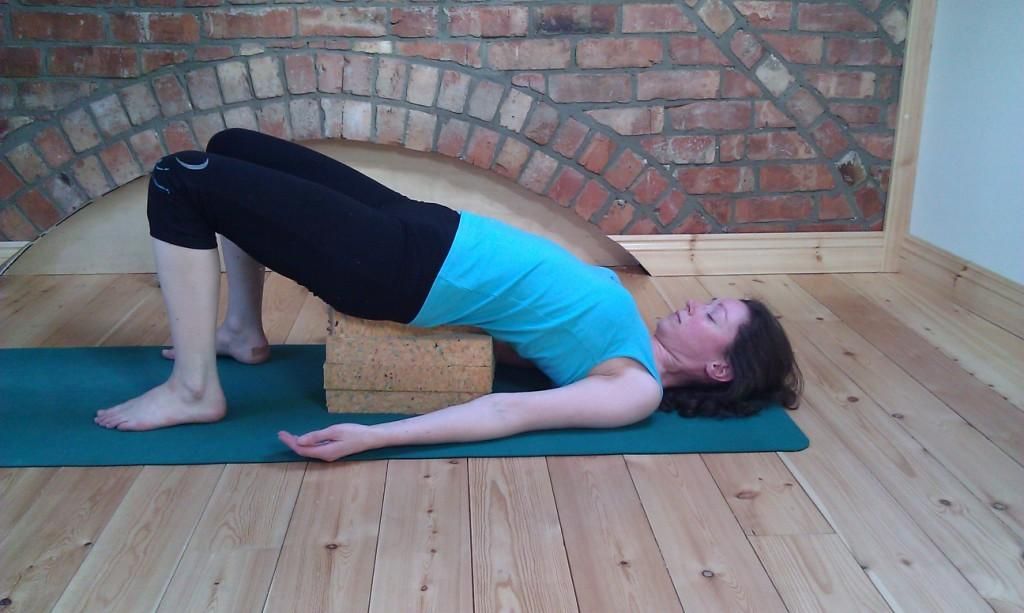
Alyson in supported bridge pose. Supported postures can be quite relaxing, if they are comfy for you.
How yoga and massage can help calm our nervous system
Calm, slow deep breaths are an excellent way to tap into our vagus nerve and activate our parasympathetic nervous system, which will then help convince the brain that things are ok, and it can dial down the pain response.
Several yoga breathing techniques focus on extending the exhale which helps us achieve this: golden breath, bramari bee breath, 'belly' diaphragmatic breathing, and ujjayii breathing.
Gentle movements can also help convince the body and brain that all is well. Managing some movements which aren't painful will help give positive feedback that things are ok, and make you feel able to achieve something.
Massage also works on the nervous system, not only through the power of touch but all the extra elements like being treated, listened to, warm space, perhaps a heated blanket on the massage table, scents, relaxing music etc.
Example of reducing PMS with massage
I had a massage client who was coming to me for massages to help her shoulder tension, stress and to feel better. After her first massage she said she felt 10 years younger! She booked a back and shoulder massage roughly every six weeks or so and one time said in the check-in chat that after the last one she’d found that her PMS (pre menstrual symptoms) and then actual period a few days after the massage had been much less painful than usual.
I had only massaged her back and shoulders.
But, as the modern theory of pain science explains, our experience of pain changes daily, monthly, yearly, depending on internal and external factors.
My client realised that when she was more stressed in work she would experience worse period pain that month. One massage happened to be just a few days before her period was due, and the relaxing and calming effects of the massage lasted for several days afterwards and meant she felt less stressed over all, and so her experience of period pain that month wasn’t as bad as usual.
Following this revelation she started to book massages to take place just before her period so that she was as relaxed as possible.
Interested in finding out more?
Check out my free 27-page e-book on Yoga for Menstrual Support. This gives a brief overview of the menstrual cycle and how we can adapt our yoga to be more appropriate to the different stages during the month. It also talks about our stress response and the modern theory of pain. Both of these systems are important to our survival but can become out of balance. We can use yoga movements, breathing and mindfuless to bring them back into balance so we can manage the symptoms of the menstrual cycle, particularly PMS and pain, more easily.
Download the free/donation e-book via the 'Shop' area of my website.
Membership offer
I also have an annual membership offer for menstrual support. This includes exclusive videos and other resources to help you with various menstrual issues.
Find out more in the 'membership' area of my website.
Alyson Tyler | FEB 18, 2025
Share this blog post



© 2026 Breathe Move Relax
