
How to make child's pose comfy for you
Alyson Tyler | FEB 3, 2025
yoga
asana
pose
modify
Relax into balasana child's pose
Balasana, or child's pose, is/was* one of my favourite poses. It can be a very calming pose, and with the head resting on something, can help a busy mind quieten down. For me the intention behind it is to rest, to turn inwards, to quieten the mind and body, and to gently lengthen the spine in a mild flexion (forward fold). You can stay in the pose for a few breaths or up to several minutes. It can be used in between poses and sequences, or as a moment of rest during a busy day, or before bed.
If you find this pose comfy, and the exhalation gradually lengthens as you rest in it, it can activate our ‘rest and digest’ relaxation response, and dial down an over-active nervous system. This helps deal with stress and anxiety, and to calm the stress response.
However, if you're someone who doesn't find it comfy, for whatever reason, it won't do these beneficial things! You might find that various muscles and joints are saying 'this is not comfy, please don't stay in this position!', or 'I don't like this, I need to move', and even experience pain sensations whilst in the posture.
If this is your experience the good news is that balasana can be be adapted in various ways, with options for the knees, upper body, arms, head and hips, in order to make it comfy for you. In this article I'm going to show you some of the options so that you can find a version that suits you.
And adapting it relates to the * earlier: it was my favourite pose, but then as a health condition (fibroids) developed, I began to find it less and less comfy, and actually unpleasant, even the wide knee variation. I switched to puppy pose instead to get the same sort of benefits without the discomfort. (And also found that after tackling some of the symptoms of fibroids, like a bulky pelvis, I've been able to enjoy wide knees balasana once again. So I'm slowly coming back to liking it again!)
Where do the arms go in balasana?
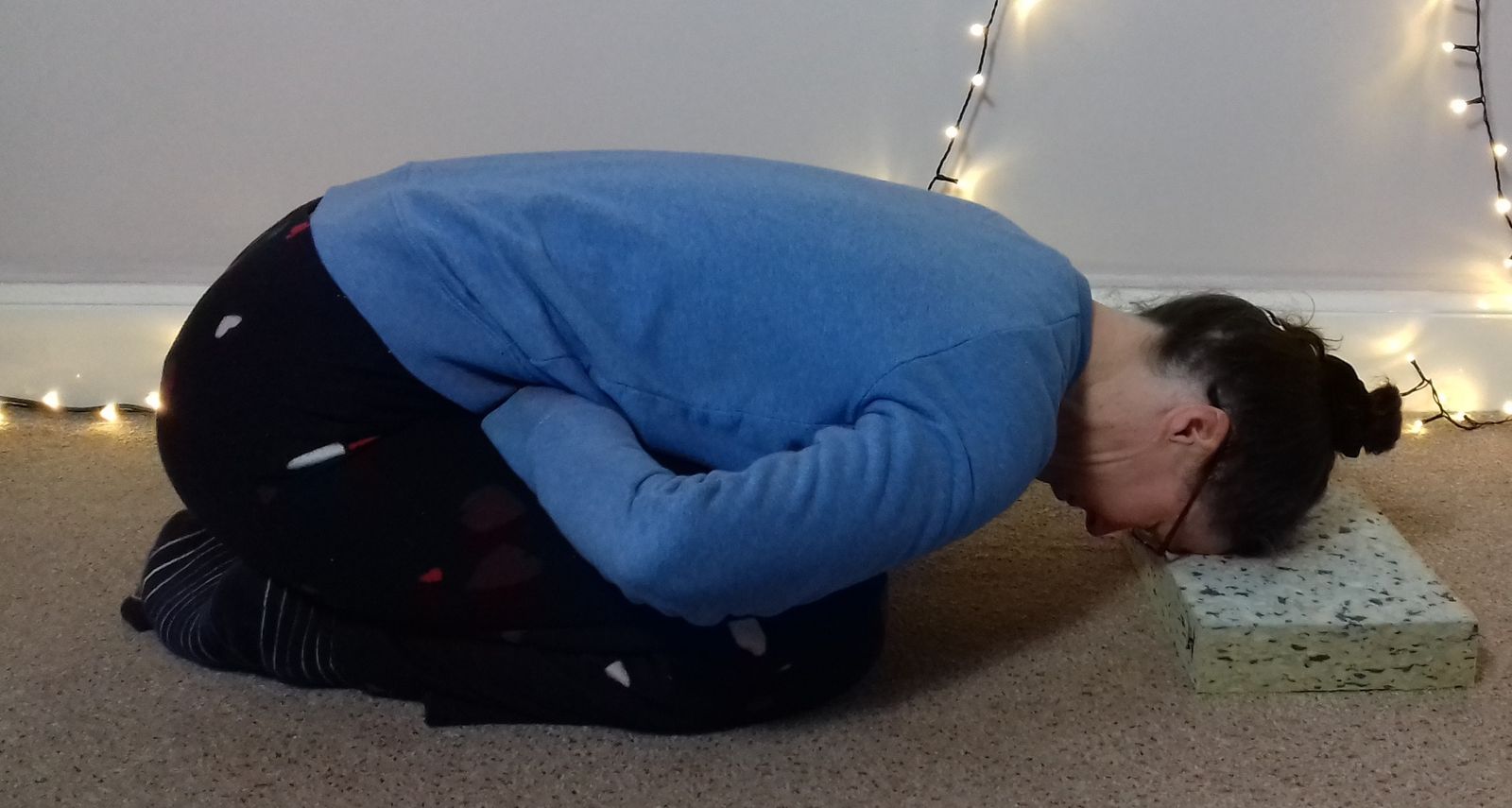
Let’s start with where the arms might go. They can be wrapped around the body with the hands near the feet (see image further down). Or they can reach forwards in front of the head (which some yoga teachers call ancestral worship), or they can be folded under the head. The latter is my default position, although I like all three!
When the arms reach forward there is more engagement in the shoulders. You can try palms up or palms down.
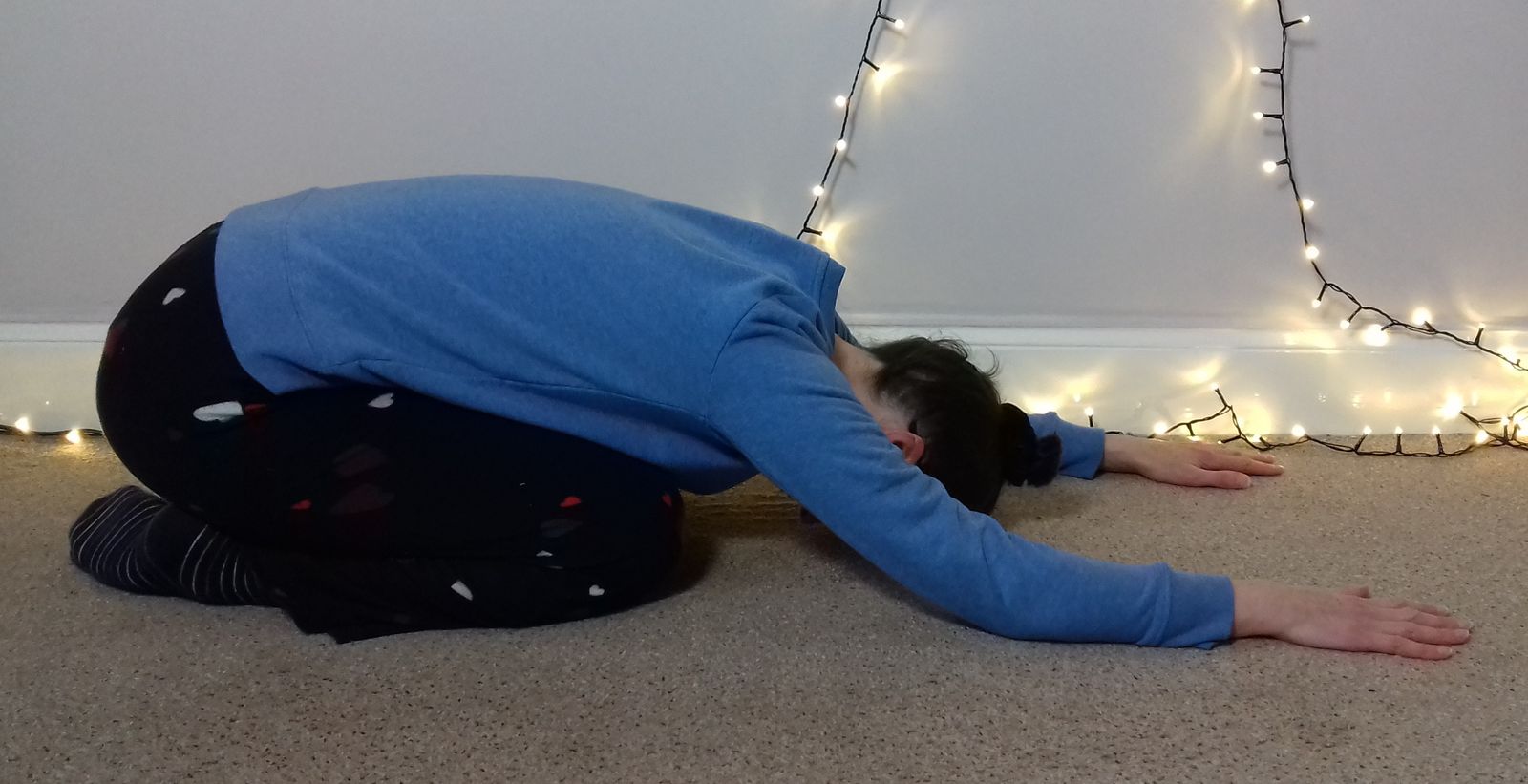
Having the arms forward is also useful if the lumbar (lower) spine is tight and rounds more in the thoracic spine area e.g. below the shoulder blades/mid ribs area. Arms forward and knees wide as a combination is also beneficial if there’s a tendency for kyphosis (rounded upper mid back), as it allows the spine to lengthen more rather than round.
Where should I put my head in child’s pose?
Once we’ve sorted out the arms, where shall we put the head? If it doesn’t comfortably reach the floor in this position, place it on a folded blanket, yoga block or similar size prop in front of you. Physically resting the head can be very calming, and you may find if you suffer from headaches, that resting the head on something helps when feel a headache coming on or have a headache. I like to fold my arms and rest my head on my arms or backs of my hands, as seen in the image below.

How to be comfy in the chest, upper body and belly in balasana
The knee position which I favour is wide knees (with toes touching), like a V shape. This gives space for the upper body, chest and belly in particular, so the abdomen isn’t squashed, and the breathing can be full and relaxed. It’s generally more comfy for many women because it accommodates breasts and belly better.
If wide knees still isnt helpful for upper body comfort, then I recommend puppy pose (see further below).
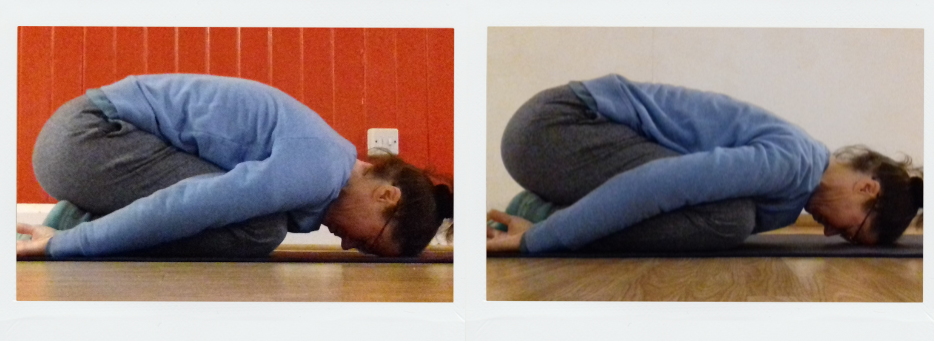
The wide knees position also lets the spine lengthen a little more, which can be helpful if your spine naturally curves at the thoracic area (kyphosis). You can see the difference in the two photos below. In the left image I have my knees together and the upper back is more rounded. With wide knees (right) my spine lengthens more, including at the lumber (lower back) area and upper mid back. If we are looking to undo body patterns that might not be so helpful e.g. overly-curved areas of spine, knees wide might be the variation to do.
How to keep the knees and ankles happy
You can use a folded blanket or towel underneath the knees for padding and added support if the floor feels too hard on the knees.
If kneeling with this deep flexion in the knees is not comfy, placing a sock or rolled up towel in the crook of the knee can help reduce the intensity (see marked up photo below.
If you have more restricted movement in the knees and cannot be into this position, I suggest a different pose: sit up and fold forward and rest head on a chair seat.
If the ankles are not happy in balasana, you can try a rolled towel under the ankles to take the pressure off them. (See photo below.)
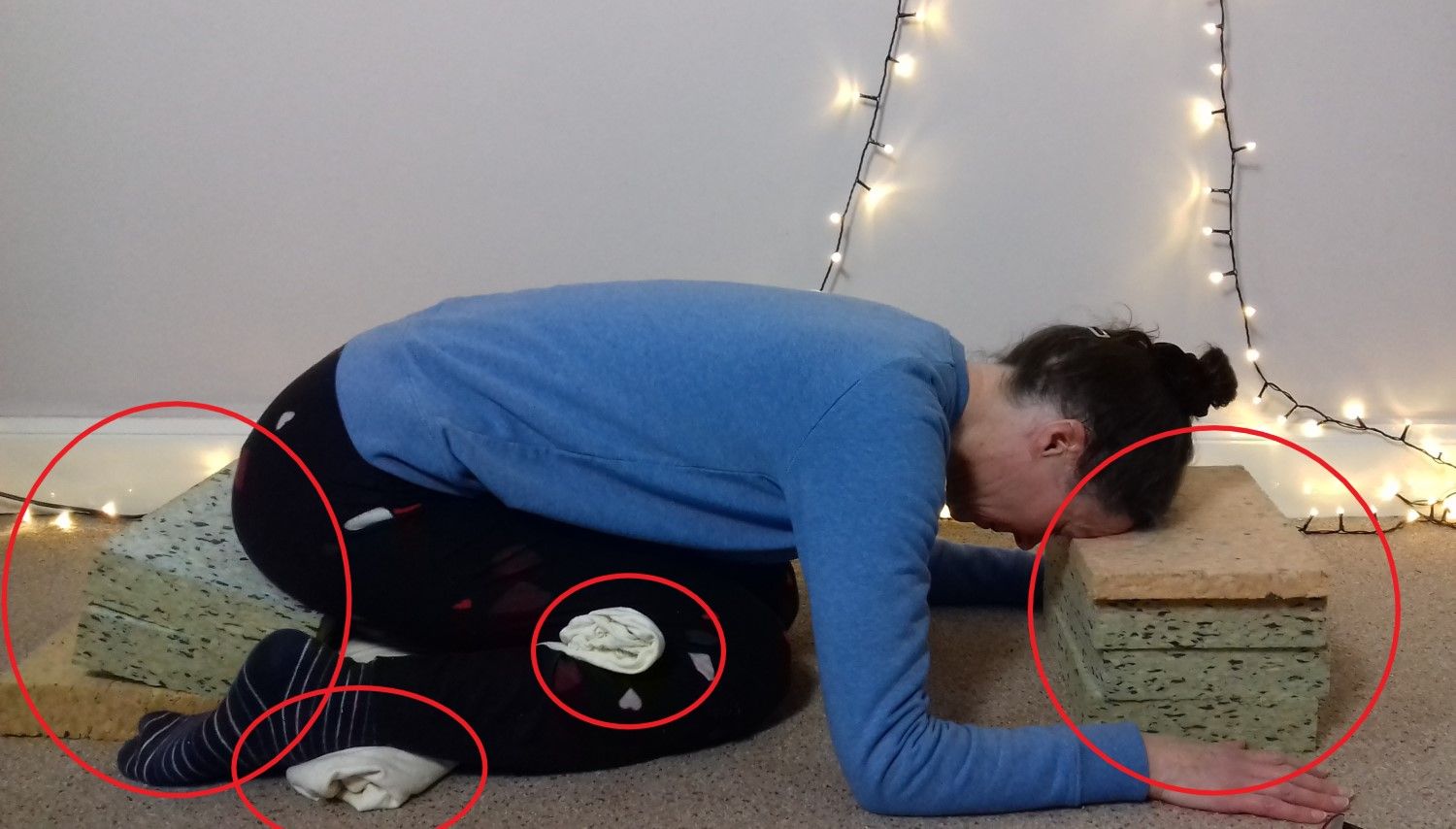
In the above image the head is also raised up. You can also support more of the body by resting the upper body on a bolster or stack of pillows. When you're in a more supported position, you may feel like staying longer. If your face feels a bit squashed into the pillow or bolster you might want a larger folded blanket for under the forehead to lift it up.
What if my quadriceps are tight and don’t allow me to sit back?
The quadriceps need to lengthen to allow the hips to move down, so if you have tight quadriceps you can pop something under the bottom so that you don’t have to sit down so deeply. The cushion/support can be between the feet, which are wider than hip width apart - see the image above. Or, you could try puppy pose (below).
Fists variation
Another variation is to place your fists into the fold at the top of thighs. For some women this can provide relief from menstrual cramps, but for some women this can make them feel worse. Try it for yourself to decide if you like it or not. Uma Dinsmore Tuli refers to this as hare pose in her book Yoni Shakti.
Puppy pose as an alternative to child's pose
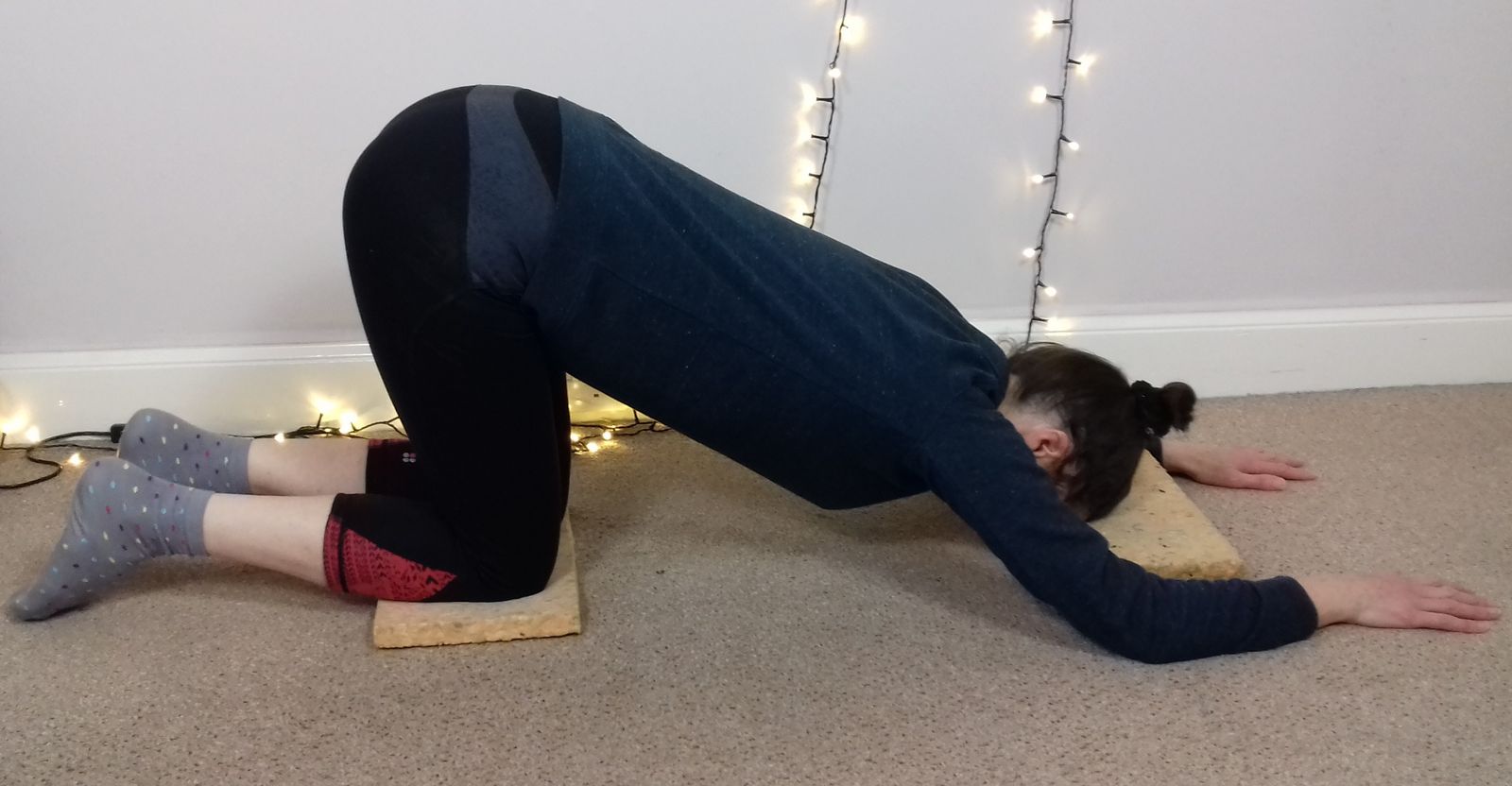
I find puppy pose is beneficial as an alternative to child's pose, in that most of the benefits are the same, such as resting the head, and calming the body.
As its name suggests, puppy pose is like a small downward facing dog pose. The hips are high, directly above the knees, and the spine is in a slight inversion so there are benefits from that. You can pad the knees especially if on hard floors. There is more space for the upper body, chest and abdomen in puppy pose which can be helpful if you find squashing these areas unpleasant.
Alternative to child’s pose if no variations are comfy
If you can’t get comfy in child’s pose, particularly if the ankles and knees are not happy, there are alternatives. If we consider the intention to rest the head and lengthen the spine in a natural way, a seated position leaning forearms and head onto the seat of a chair would be good, especially if sat on a block or two to help lift out of the hips and create freedom in the lower spine.
If you are pregnant, child’s pose may feel ok whilst the bump is still small, especially if you do the ‘knees wide’ variation, but a deep forward fold isn’t appropriate after 4-6 months (or earlier if it’s uncomfortable), so taking a seated version to a chair would be more helpful.
(All images copyright Alyson Tyler.)
Alyson Tyler | FEB 3, 2025
Share this blog post



© 2026 Breathe Move Relax
